History and Purpose of Steam Sterilizer
Explore the history of steam sterilizers, from Charles Chamberland’s early autoclave in 1879 to today’s automated systems. Learn how steam sterilization works, why it remains essential for infection control, and how hospitals, clinics, laboratories, dental facilities, and pharmaceutical industries use it to process compatible instruments safely and reliably.
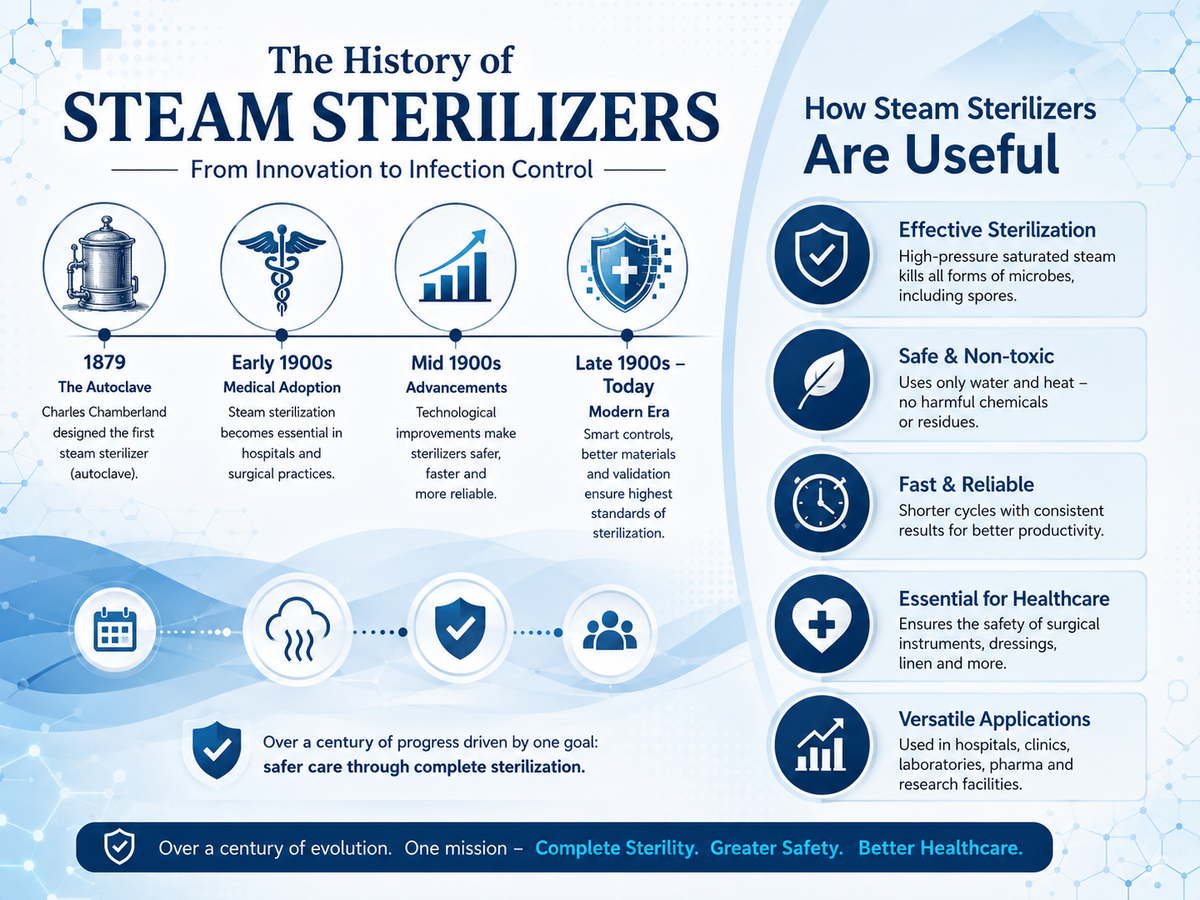
History of Steam Sterilizers: From the First Autoclave to Modern Infection Control
Steam sterilization is one of the most important developments in healthcare, laboratory science, and infection prevention. Before dependable sterilization methods existed, reusable instruments and laboratory equipment could carry harmful microorganisms between patients or procedures. The steam sterilizer, commonly called an autoclave, changed this by providing a controlled method of destroying microorganisms with saturated steam under pressure.
More than a century after its introduction, the steam sterilizer remains widely used in hospitals, clinics, dental practices, laboratories, pharmaceutical facilities, and research centres. Modern systems are faster, safer, and more automated than early autoclaves, but they use the same principle: direct contact with saturated steam at the required temperature and for the required time can sterilize compatible items.
The Beginning of Steam Sterilization
The history of the steam sterilizer began in the nineteenth century, when scientists were establishing the relationship between microorganisms, contamination, and disease. This created an urgent need for reliable methods of sterilizing medical and laboratory equipment.
In 1879, French scientist Charles Chamberland, who worked in Louis Pasteur’s laboratory, developed a pressurized disinfection chamber known as the Chamberland autoclave. His work began with sterilizing culture media, and the autoclave soon became important in bacteriology laboratories, surgical departments, and disinfection facilities.
By sealing steam inside a pressure-resistant chamber, an autoclave can operate at temperatures above the normal boiling point of water. This provides a more dependable process than ordinary boiling and became the basis of modern moist-heat sterilization.
Early Adoption in Healthcare
During the early twentieth century, hospitals increasingly adopted steam sterilizers as knowledge of infection transmission improved. Healthcare institutions recognized that reusable surgical instruments required more than washing or boiling before safe reuse.
Early hospital autoclaves were simple compared with modern equipment. Operators manually controlled steam admission, pressure, temperature, and exposure time. Although these systems required close supervision, they provided a more consistent process than earlier methods.
Their adoption in operating departments, laboratories, public-health facilities, and research institutions supported safer surgery and helped establish sterilization as a routine part of healthcare.
Development During the Mid-Twentieth Century
Throughout the mid-1900s, manufacturers introduced stronger chambers, improved pressure control, more reliable temperature measurement, better door locks, and safer operating procedures.
Two important configurations became widely used: gravity-displacement and pre-vacuum sterilizers.
Gravity-Displacement Sterilizers
In a gravity-displacement sterilizer, incoming steam pushes cooler, heavier air downward and out through a drain or vent near the bottom of the chamber. As the air leaves, steam fills the chamber and surrounds the load.
These cycles are suitable for many solid instruments, glassware, liquids, and compatible items. However, removing air from wrapped, porous, or complex loads can be more difficult.
Pre-Vacuum Sterilizers
Pre-vacuum sterilizers use a vacuum pump to remove air before the exposure phase. Vacuum pulses improve air removal from packaging, porous materials, and instrument cavities.
Once air is removed, steam can penetrate the load more rapidly and uniformly. This makes pre-vacuum systems particularly useful in hospital sterile-processing departments processing wrapped sets and complex instruments.
These developments improved steam penetration, temperature uniformity, drying, and cycle repeatability.
The Modern Steam Sterilizer
Modern steam sterilizers combine established sterilization principles with automated controls, digital monitoring, and advanced safety systems. Depending on the model, they may include programmable cycles, touchscreen operation, automatic door locking, vacuum-assisted air removal, drying cycles, alarms, electronic data storage, and printed reports.
Sensors continuously monitor time, temperature, and pressure. When programmed conditions are not achieved, the sterilizer can generate an alarm, interrupt the cycle, or identify the load as unsuccessful. This reduces the risk of incorrectly processed instruments being released.
Many systems also provide user identification, load tracking, password-controlled operation, and electronic documentation. These features improve traceability and help facilities maintain sterilization records.
Why Are Steam Sterilizers Useful?
Effective Sterilization
When correct conditions are achieved throughout the load, saturated steam can inactivate bacteria, viruses, fungi, and resistant bacterial spores. This makes it suitable for many critical reusable medical devices.
Pressure itself is not the sterilizing agent. It enables steam to reach elevated temperatures. Effective sterilization depends on steam contact, correct temperature, sufficient exposure time, air removal, and proper loading.
No Chemical Sterilant Residue
Steam sterilization mainly uses water and heat. It does not require a chemical sterilant cartridge for every cycle, and compatible instruments do not normally need an aeration period after processing.
This makes steam a practical and non-toxic option for materials that tolerate heat and moisture. The World Health Organization recommends steam as the preferred sterilization method for suitable heat-stable devices.
Fast and Reliable Processing
Steam cycles are generally faster than many low-temperature processes, allowing hospitals and clinics to process instruments efficiently.
Total cycle time depends on the sterilizer, programme, load, packaging, air-removal method, exposure temperature, and drying requirements. Wrapped instruments, textile packs, and porous loads may require different exposure and drying times.
Reliable Process Monitoring
Steam sterilization can be monitored through physical, chemical, and biological methods. The sterilizer records time, temperature, and pressure. Chemical indicators demonstrate exposure to selected conditions, while biological indicators use resistant bacterial spores to challenge the process.
Together, these methods help facilities detect failures and verify sterilizer performance. Biological monitoring is particularly important because it provides a direct challenge to the sterilization process.
Cost-Effective Operation
For facilities with regular instrument-processing requirements, steam sterilization can be economical. The main utilities are generally water, electricity, or an external steam supply, without a separate chemical sterilant for each cycle.
Actual costs depend on water and energy use, maintenance, loading practices, cycle selection, and equipment efficiency.
Where Are Steam Sterilizers Used?
Hospitals and Central Sterile Services Departments use steam sterilizers for surgical instruments, trays, textiles, and approved reusable devices.
Dental clinics use smaller autoclaves for mirrors, forceps, scalers, and other reusable instruments.
Medical and research laboratories use them for glassware, culture media, reusable tools, and certain biological waste.
Pharmaceutical and biotechnology facilities may use steam sterilization for equipment components, containers, product-contact parts, and compatible materials.
Veterinary hospitals and clinics also use steam sterilizers for reusable surgical and treatment instruments.
What Can Be Steam Sterilized?
Common steam-compatible items may include stainless-steel surgical instruments, dental instruments, laboratory glassware, textile packs, certain rubber products, approved plastics, instrument containers, and some lumened devices.
Every item must be processed according to its manufacturer’s instructions for use. A device should never be autoclaved simply because it appears strong, reusable, or metallic.
Steam Sterilization and Patient Safety
A steam sterilizer is only one part of a complete reprocessing system. Instruments must be thoroughly cleaned before sterilization because blood, tissue, inorganic deposits, and other contamination can form a barrier between the sterilizing agent and the instrument surface.
A proper workflow includes collection, cleaning, rinsing, drying, inspection, assembly, packaging, loading, cycle selection, monitoring, cooling, documentation, storage, and distribution. The World Health Organization describes medical-device decontamination as a sequence of connected processes rather than a single sterilization step.
Correct loading is also essential. Overloading the chamber or placing packs too closely together can restrict steam circulation and prevent effective air removal or drying. Staff should follow validated loading patterns and the instructions supplied by the sterilizer and device manufacturers.
Routine maintenance, calibration, leak testing, air-removal testing, and biological monitoring help ensure continued performance.
Conclusion
From Charles Chamberland’s autoclave in 1879 to today’s digitally controlled systems, the steam sterilizer has played a major role in the development of safer healthcare.
Its lasting value comes from a simple principle: saturated steam, applied under the correct conditions, can provide effective sterilization for compatible instruments and materials.
Modern steam sterilizers offer automated operation, reliable monitoring, improved traceability, rapid processing, and advanced safety controls. They remain essential in hospitals, dental clinics, laboratories, pharmaceutical facilities, veterinary centres, and research institutions.
More than a century of innovation has transformed the autoclave, but its purpose remains unchanged: supporting effective sterilization, safer procedures, and better patient care.